
Work - Play - Compete Part 1
The Rise Of Superman and other stuff
Brian McCormick, one of my favorite coaching writers on Substack, wrote an article entitled Playful Practice or Practicing like a Pro. I recommend checking out the full article. In it, he shares a quote from Steven Kotler and his book The Rise of Superman:
If we are hunting the highest version of ourselves, then we need to turn work into play and not the other way round.

When I read that quote, I felt a wonderful ah-ha! moment, like somebody just flicked a light on that made the room 30% brighter. I felt this way basically the whole time I attended my first GMS clinic a long time ago… I had been working hard as a coaching, trying to figure things out on my own and stumbling toward things, and then Carl would say something and I’d think, “yes, that’s what I mean to do/think/say!”
I love this quote because I think it hits on so many things that are important to coaching, and reflective of the way I coach — at least when I’m coaching at my best. Brian’s article is a bit more training-oriented, but I want to zoom one step out and be a little more philosophical.
Here’s a few thoughts on the interactions between work and play.
It Takes A Lot Of Work
Significantly improving in any endeavor is not easy. Most Practice Doesn’t Do Anything, so you either need to practice a lot, in order to make up for inefficiency on sheer volume, or you need to practice really well. Deliberate Practice is not easy. Something that makes Deliberate Practice so difficult is, for many learners, practicing deliberately constantly knocks you out of flow.
Flow is an immersive state and it feels good to be in flow. When we’re doing activities that create flow, time flies and there’s a much lower perception of effort. It would be great to stay there a lot!
And yet… we also need Deliberate Practice. Maybe.
I don’t know know that you need much Deliberate Practice to get good at something, particularly if you have some talent for it. If you’re fairly tall and move fairly well, you can get pretty good at volleyball by just playing. However, in order to get great, or in order to significantly change your natural development arc, Deliberate Practice becomes important.
Learning To Play
Do kids naturally play? Yes and no. While there’s no question that all (or at least most) humans have an innate desire to play, not everyone naturally plays in a way that works well with others, or with the environment of which they are a part. The simplest way to illustrate this is to imagine somebody playing volleyball without knowing the rules. If you happened upon a casual game of volleyball and it was your first time ever having seen the sport, you might have a natural desire to join in, but you might frustrate yourself or others because you don’t realize your team is only allowed 3 contacts, or that you aren’t allowed to catch the ball or let it bounce, etc. This is a simple example, but I think it illustrates a general concept: play is more fun when you know the rules.
Rules don’t have to be strict boundaries of a game; they can be rules of thumb that, when mostly followed, allow for a better overall experience for everybody. For example, the Yes And… rule is suggested for improv theater or other games involving shared scenario creation. Anyone who has a child has probably experienced phases where that child’s definition of “play” means “ordering everyone else to do exactly what they say to create some scenario they imagine in their head which will ultimately never be fully realized leading to sadness and anger for everyone.”
Likewise, volleyball players don’t always know how to play well with others. I’ve written about the importance of Learn To Learn before, but many kids also have to Learn To Play. This is especially true for young teenagers, many of whom have their “play muscles” either deconditioned or intentionally trained out of them over the previous half-decade. In particular, adolescent girls often go through a phase of socialization where play shifts away from physical contests and toward social or emotional battles with peers. It sounds odd, but many kids need some help figuring out how to engage in physical play (aka sports) in a way that is fun for everybody involved.
Work Or Play?
One of the challenges of youth sport is that many of the adults bring their own baggage with them. There are parents and coaches who never quite reached their potential as athletes and desperately want to help their kids reach full potential. There are coaches who coach the way they were coached. There are also coaches who coach in a way where they are clearly trying to undo the offenses against them by previous coaches. Because I think most people are good, I think most coaches and parents involved with youth sports are trying to do right by the kids, but it’s hard to see things through an accurate lens. So this intention is not always realized.
Remember also that There Are No Blank Slates. Every player that comes into your program has a different history and background. They have different experiences and thus have had different interactions with both work and play. Playful coaches sometimes struggle with players who enter the program with a, “no pain, no gain,” attitude. When a player like that hears, “we have to loosen up and have fun out there,” that player might think, “my coach isn’t as serious as I am.” On the flip side, very serious coaches might lose a player who is naturally more improvisational or less technically-minded. This player might feel like they are playing poorly because they are being asked to overthink things they do naturally — or at least think they do naturally.
I’ve believed in this idea of turning work into play for a long time, but the quote that began this article presents it in more clear way than I’ve said it before.
I texted this quote to our team group chat earlier in the week:
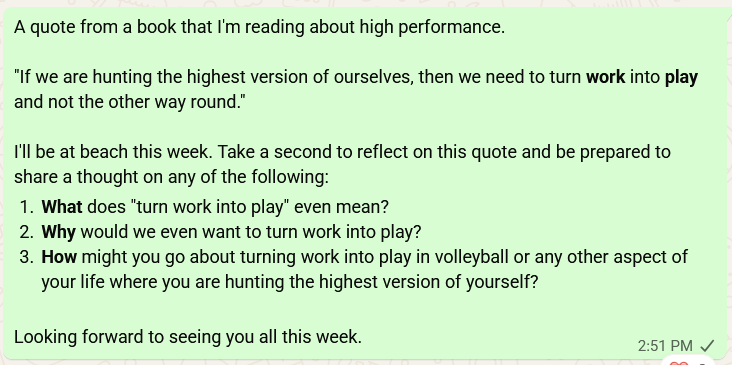
I’m fortunate to coach lots of good kids who both love to play volleyball and are willing to “work” at it as well. I was curious what thoughts they would have. While there was some variety, a common theme emerged and it surprised me. I’ll roughly paraphrase it as:
