
Summer School 2026
More learning and stuff
Last year, at the start of summer, I published the first article in a series I titled Summer School. If you want to check those out, go to Summer School Part 5, which has links to the other 4. Some other article series that people liked from last year were the Tactical Tuesday and 5-Convo Friday series.
All of those articles tend to draw from my holy trinity of coaching books:
The Language Of Coaching - Nick Winkleman
How We Learn To Move - Rob Gray
Coaching Athletes To Be Their Best - Rollnick and Fader
This summer, I want to organize a lot of my coaching writing around three jobs every coach has to do: design better drills, teach players more clearly, and guide athletes toward better behavior. These are the three books that most shaped how I think about those jobs.
First: Throat-Clearing
I don’t think any one source in coaching has all of the answers, and I think coaching has an interesting combination of solutions that are both progressive and cyclical. What I mean by that is improvement or innovations in sport often come from two camps:
Building upon what a previous coach/player/team did. An example is the rise of jump-setting in beach volleyball. It seems like each season more players are putting this into their game and branching off into whole new offensive systems.
Rediscovering something that was dormant for a while and often implementing it in a slightly different way. I can’t dig it up, but I read an interview with Urban Meyer talking about his spread option offense where he basically said, “yeah what we’re doing is basically digging up old single-wing football from the 50s but with X, Y, Z new pieces added to it.1
So when I say a bunch of this stuff, I’m talking more about my personal journey and where I pull sources from. The single-most influential book that I ever read was The 4-Hour Workweek. When I scan through that book now, as an almost-40-year-old in 2026, it doesn’t seem mind-blowing. Efficient business practices, remote work, solopreneurship, geo/currency-arbitrage. All of this stuff is pretty common practice by now. And there’s plenty of ways to learn about that stuff. But I read that book when I was 22 years old in 2009 and it’s what helped me make the jump to drop out of grad school and pursue coaching full-time.
All this to say: I love these 3 sources for what they represent to me (which I’m about to explain) and how they’ve clarified pieces of the coaching puzzle for me. I don’t claim that Nick Winkleman invented external cueing, but I like his process the best and therefore, as a SmarterVolley subscriber, it’s the textbook you’re going to have for SmarterVolley Summer School.
3 Pieces Of The Puzzle
I’ve written extensively about these books previously, but there are new subscribers and I want to use this article as a reference point, so let me state why I choose these three books.
Coaches have lots of roles. The job of “Coach” is a bunch of different jobs; several of which (such as Tactician/Strategist or Travel Coordinator) I’m not going to get into now. But I will talk about 3 sub-roles of coaching:
Drill Designer
Tutor
Mentor
Each of these three sub-roles roughly corresponds to one of the above books and I believe that these three sub jobs correspond to the main skills that coaches need to have to help players get better at volleyball. Your Systems are the “What” and your understanding of the statistical realities of the game is the “Why” behind what you’ll coach. The three sub-roles are the nuts and bolts of the “How” you’ll accomplish things on a day-to-day basis.
Drill Designer
I differentiate Drill Design from Practice Planning. Practice Planning is important, but I don’t think it’s a lifelong skill for most coaches. You can do just fine running the same Template over and over again. Most seasons require quite a bit of planning right in the beginning to get your Template and Season Blocks laid out. But once you have that down, you’re on easy street.
Drill Design, on the other hand, is a different skill. The way I think about Drill Design is that it’s totally unimportant until it is. What I mean by that is that, in a given day, whether you play 3v3 or 4v4 doesn’t really matter all that much. Over the lifetime of a player’s career, that one decision probably doesn’t even matter either. I happen to love 4-Ball Passing for club volleyball teams who can’t break out into separate courts for serve/pass activities. However, there’s plenty of players who get really good at passing and never do 4-Ball Passing. The drill itself is completely uncorrelated to getting good at passing.
One of the tricky parts about coaching is that there’s a randomness to it. There is no guarantee that any given practice will help a player improve their skill. You might even say that Most Practice Doesn’t Do Anything. But there’s degrees of randomness. Poker is random; there is luck involved. Yet poker is unquestionably a game of skill. How do you determine a game of skill v a game of luck? It’s not so much whether you can win… the best test of a game of skill v luck is whether you can intentionally lose. To continue the poker example, there’s no guarantee that a given player will come out a winner in a session of play, much less a given hand. But it’s very possible to dramatically increase your odds of losing a given hand and you can guarantee a loss on a given session by playing poorly. In contrast, a game like roulette is impossible to affect either way; there’s no way (given the same overall betting amounts) that I can try to lose faster or slower than you. Thus, there’s no skill component.
Yes, this is related to Drill Design. What I mean by this is that the main thing about Drill Design is less about designing the perfect drill and more about not doing unhelpful things at practice. The tough thing about Drill Design is that it’s very midwit.
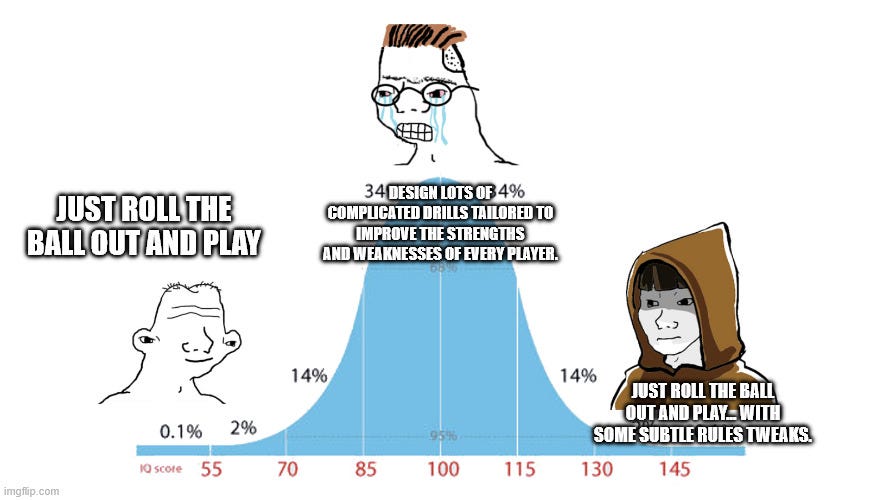
You have to assume the base level of a practice is just scrimmaging the whole time. Scrimmaging is a productive activity! It’s not maximally productive, but if you coach a team, and the only drill you ever do is scrimmage, you could absolutely be above-average in your rate of improvement.
But we don’t coach to be above-average! We coach to be great! So then we design lots of additional drills… and then we risk doing stuff at practice that is less productive than just scrimmaging.
So Drill Design doesn’t matter until it does.
How We Learn To Move is the first book written by Rob Gray. He’s written more books and he has a podcast of his own and sometimes appears on other podcasts. He’s a pretty prolific guy. I consume as much of his stuff as possible, and you could argue that Learning To Be An Ecological Coach might get you there faster if you started with that one. But I didn’t start with that one, so How We Learn To Move tends to be the book I reference.
I feel like I sometimes spend more time criticizing the ecological approach to coaching than writing about it or describing it. I think that direct instruction has a lot of value and “muscle memory,” while probably not being a thing, is a useful description of how some things are learned for some people at some time. That said, I want to spend a little more time this summer talking about how the ecological paradigm (and more specifically, some of the ways that Rob Gray describes this paradigm) influences how I coach.
Here’s my best short summary of it:
When volleyball players move to accomplish an action, there’s a 3-way interaction between themselves, the task, and the environment. The player’s self-perception both influences how they will try to accomplish a task in a given environment and is influenced by the task and the environment. The tasks a player is asked to do influences the player’s perception of the environment and the environment influences the perception of a task.
That paragraph is pretty jargony, and I’ll unpack it more this summer. But just to give a few very simple translations:
Give two players the same set and the big player might swing at the ball one way while the small player might swing at the ball another way.
Give the same player the same instruction and he will respond differently when he is feeling confident/nervous/angry/calm/etc.
Give the same player the same set and she will swing differently depending on whether the block/defense seems bigger/smaller/faster/slower/etc.
Two swings off the exact same set with the exact same approach against the exact same block/defense might seem different (and thus the player might swing differently) when the game is 0-0, 15-15, or 24-24.
This is why I say that 3v3 or 4v4 doesn’t really matter. They mostly just matter such that you understand what kind of situations they are going to create. This is also why I do the same practice templates and therefore the “same” drills over and over again. When you play Jamball a lot, you get a feel for how certain players will interact with that game, because the game looks pretty different depending on the size of players, their confidence level, their trust in their teammates, who they are intimidated by, etc.
Tutor
The favorite sub-job of many coaches is what I call Tutor. This is basically the small-scale teaching process between player (or small group) and coach. “Hey, here’s how you make this set,” or, “try creating an angle this way,” are things that get said when coaches are in Tutor mode.
Tutoring can occur within a large-scale practice. I’ve written about Tutoring specifically before, and it’s probably one of the most reliable ways to get your practice to actually do something. In many ways, I visualize player improvement as mostly being individual tutoring + 6v6 systems work and try to avoid a lot of stuff in the middle.
There’s obviously overlap between Practice Planning/Drill Design and Tutoring, because you only have so much gym time and so many courts and a certain number of players, so if you want to be able to Tutor them, you have some logistics to figure out, assuming you don’t want everybody else standing on the sidelines watching you tutor 2 kids at a time.
Let’s set that aside. What I want to focus on here is the specific teaching connection and how things get explained. Coaches have tremendous power to clarify things for athletes and help them make connections faster. They also have tremendous power to put an athlete into cognitive overload and slow down the learning process. One reason that Most Practice Doesn’t Do Anything is that when learners get overloaded, they don’t retain anything and thus no improvement happens. The tricky part here is that, since There Are No Blank Slates, athletes will very often overload themselves! There’s definitely plenty of players who lack focus and will essentially concentrate on nothing while they play. But there’s probably an equal number (maybe even a greater number) of players who will focus on too much/the wrong thing and mess up in the other direction. Good teaching helps get athletes to the golden mean in the middle.
Nick Winkleman’s book is the most practical book I’ve ever encountered for how to adjust how you speak to athletes, in order to better assist the learning process. My best short summary of how I use this information in a volleyball practice:
An athlete’s intent is the most important influence on the outcome of a play/movement/action. Intent is what they want their movement to accomplish and their internal visualization of what that looks and feels like. Coaches should prioritize influencing an athlete’s intent and constantly check for understanding. Attention is how athletes change their intent or modify movements as intents change. Attention is the currency of coaching and influencing what athletes “pay attention” to is a critical job of coaches.
There’s a lot of value in just gaining some new ways to say things. Check out the 99 External Cues series for some ideas. But the even deeper idea here is this interaction between movement, attention, and intention. My model for it is:
Intention → Attention → Power → Energy
Intention is literally what the player wants to do. “Serve the ball in,” or “Hit the ball hard,” are valid, if unrefined, intentions. Most players lack intention or have scrambled intentions. The tail often wags the dog. Again, there’s often a midwit effect in play here as many elite players think about the game in a much simpler way than mediocre players. Many coaches compound this by overcomplicating things; in a desire to teach faster, they slow down the learning process.
There’s lots of overlap between Attention and Intention and very often, players need to put their Attention on just having the basic Intention of executing the play. Again, “hit the ball hard,” is not only a perfectly valid Intention but it is a perfectly useful thought to occupy an athlete’s Attention. It’s not always ideal, but it’s better than what many athletes think. As athletes become more clear in their Intentions, they start to understand how changes to their Attention affect the outcome. “Finish fast,” “finish strong,” and, “finish high,” might influence the outcome in different ways.
Power is the physical execution of Attention. Smaller/younger athletes can often move in a way that’s very similar to bigger/older athletes, just with less power. The fundamental mechanics in these two plays are basically identical:
But there’s a big difference in power/execution!
To paraphrase Tony Holler, “power grows like a tree,” meaning: slowly and over time. However, Attention also influences power! There are attentional cues that nudge an athlete more toward increasing accuracy/touch and attentional cues that nudge an athlete more toward power. Winkleman’s book, and his general process, help coaches understand this.
And finally, Energy is the ability to apply power over time. There’s a physical definition, but there’s also a psychological and team application. “If you can do it once, you can learn to do it every time,” applies to the skill execution by one player on a given play. Individuals learn to execute with Power over time by building and sustaining Energy. Teams gain the Power to finish close sets by building and sustaining Energy. That’s a tricky one and more of a topic for another day as Winkleman doesn’t get much into that.
Mentor
Coaches are influential figures in the lives of young people. Big concepts like “inspiration” and “motivation” and “influence” and “guidance” are hard to pin down. What do they mean? Fundamentally, it’s about turning words into works aka changing behavior. As Rachel Dawes might say, it doesn’t really matter what you aspire to be to your athletes (as a mentor, leader, etc), it matters what you help your athletes do.
Let me use a very simple example. Many players let balls drop on defense without diving for the ball. Those players don’t really care about winning. They don’t want it bad enough! But yet, after the game, some of those same players will be crying because they lost. They did want it after all?
Neither. For most of these players, they simply aren’t very good at diving. When they aren’t good at diving, it hurts to dive, plus it hurts even more to dive after a ball and mess it up and look like a big dummy when you mess it up. It’s usually not the little waterbug who is really good at diving who doesn’t dive, ya know?
The same goes for other behaviors that are less clearly skill-linked. Most players who come to practice late don’t want to let their teammates down. Most players who lose focus and start chatting during a drill don’t see themselves as lazy good-for-nothings. Yet players all over the country are doing these and other self-defeating behaviors all the time.
The Motivational Interviewing framework laid out by Fader and co. both (a) confuses me with its name, because it appears to have nothing to do with interviewing as I understand the word and only a little with motivation and (b) is the best framework I’ve learned to help steer athletes toward positive behavior change. It helps them connect being with doing.
My summary of the practical application of this book is:
Change is difficult when emotions are involved. When athletes are emotional, direct intervention is often counter-productive and can backfire to produce the exact opposite result intended. (This is in contrast to asking for a behavioral change an athlete has no emotional tie to in a situation where the athlete is not in an emotionally-charged state. In those situations, direct and clear instruction is often best.) Influence is difficult without rapport and a good way to build rapport with an athlete is to identify and reflect their feelings. When coaches understand the core values/aspirations of an athlete, they can help players connect behaviors to those values/aspirations. When athletes can see these connections, they will often express a desire for new behaviors, at which point the coach can engage in more direct instruction.
Whew, if you’re a numbers guy like me, it might have been draining just reading that last paragraph. But sometimes the hardest roads are the ones worth choosing.
Summer School Curriculum
I’ll write more about these three coaching roles and reference these books (or others by the same authors) quite a bit. I don’t do book reviews on here because I think you should usually just go right to the source. What I will do is highlight and share the applications of what you actually do with this knowledge. A few topics I have on hand are:
More cueing and teaching to improve your tutors.
An additional article on how to make practice more tutorlike, even when you have a bunch of kids on one court.
Drills within drills or how to keep templates consistent while teaching different things.
How to help athletes identify strengths without them becoming limiting labels.
Leave a comment or send me an email with some related topics you’d like me to hit and I’ll see if I can include them as well.
Obligatory: I think it was Urban Meyer and I think he referenced single-wing from the 50s, but this was like 15 years ago and I’m not spending 2 hours tracking that down for this comment. I think you get the point.
Love the reading list, ty! Would you consider expanding your holy trinity to a holy quadrinity including Coach Your Brains Out? I've used CYBO as a bookclub (aka "let's get aligned on how we're doing this") with my fellow coaches multiple times. I consider CYBO to be my coaching bible, though I did just finish How We Learn To Move (tyvm for the rec!) and got a lot out of it.